Sedona Pix
Arches and Hoodoos
A road trip across the quiet heart of the Colorado Plateau
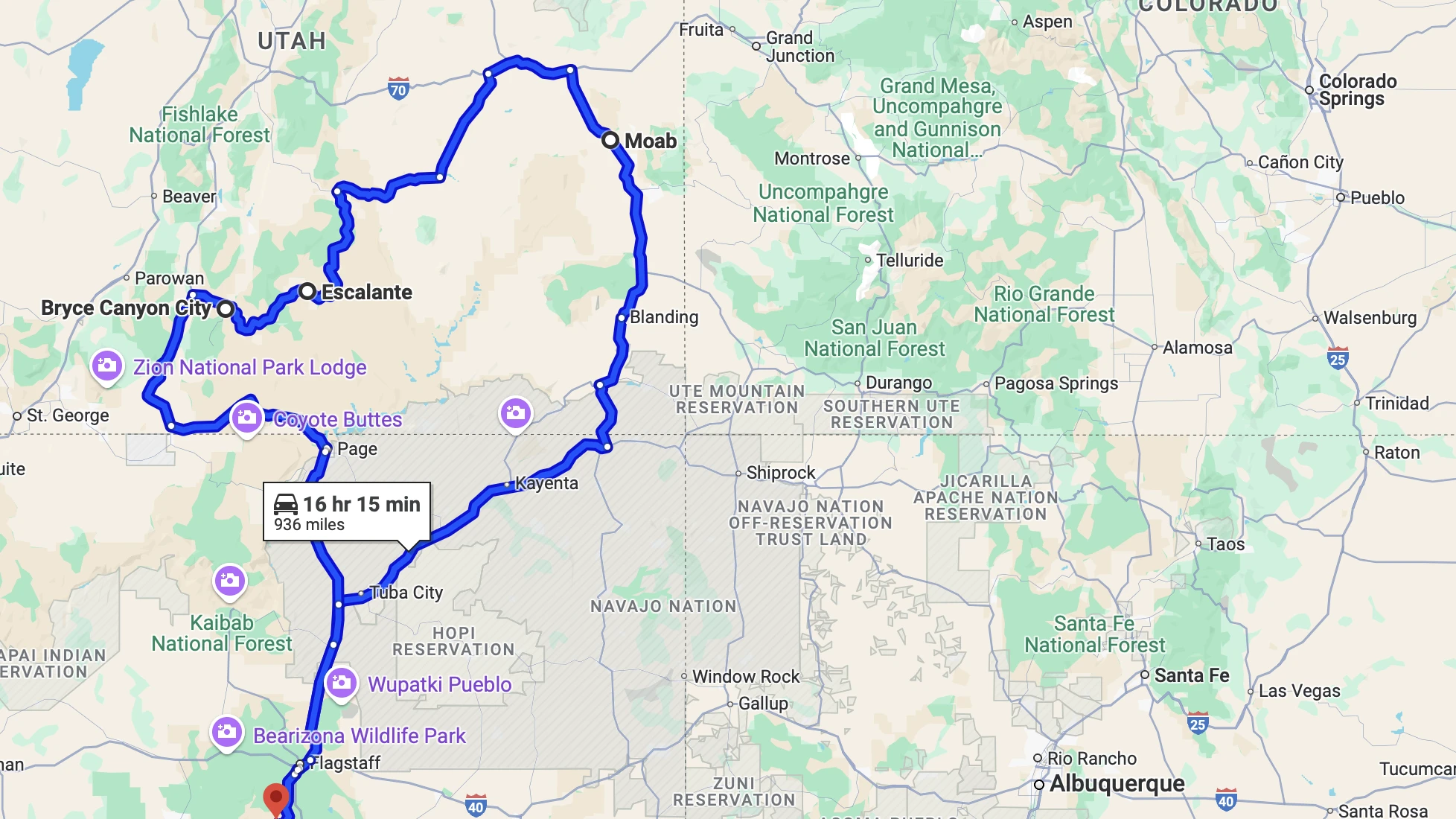
A long loop from Sedona to Moab and back, with stops in Arches, Bryce Canyon, and a few quiet places in between that don't get much attention — and maybe that's a good thing. A good old-fashioned road trip with a few memorable hikes, some bad pizza, and a whole lot of beautiful sky.
Sedona to Moab – 355 miles
Route: Sedona → Flagstaff → Cameron → Tuba City → Kayenta → Dennehotso → Bluff → Moab
We left Sedona around 9 a.m., climbing out of the red rock basin through Oak Creek Canyon. The switchbacks of Highway 89 rose beneath a pale, unsettled sky. The cliffs were still wet from the previous night's storm, their colors deepened by the rain. By the time we reached Flagstaff, the ponderosa pines were shaking off a cool breeze, and patches of sunlight filtered through the clouds.
From there, the landscape opened into the Painted Desert, a strange and beautiful expanse of layered stone and wind-scraped plateaus. We passed through Cameron, then followed Highway 160 through Tuba City toward Kayenta. At the junction of Highways 98 and 160, flashing lights marked a serious accident, likely the result of another sudden desert downpour. The highway shimmered under low clouds, slick with runoff.
Kayenta provided a brief pause: bathroom break, stretch, and back on the road. We continued past Dennehotso (elevation 5,069 feet, population 491), Tes Nez Iah, and the weathered remains of the Mexican Water Trading Post. This is not a wealthy part of the country. According to the 2000 census, more than a third of families lived below the poverty line, and little suggests that conditions have improved significantly since then.
After crossing into Utah on U.S. 191, traffic thinned and the pavement noticeably improved. Just south of Bluff, we stopped at the Twin Rocks Cafe and Trading Post, tucked beneath the towering Navajo Twins formation. The place felt like a holdout from another era. The staff greeted us warmly, genuinely seeming glad that travelers had made it through the storm. Although the trading post dates back only to 1989, it feels much older, shaped by decades of sand, wind, and stories.
We continued north through White Mesa, Blanding, and Monticello, with storms surrounding us on every horizon. Thunder rolled overhead, lightning flashed across distant mesas, and rain returned in waves. By the time we rolled into Moab around 5 p.m. Mountain Time, the skies were finally beginning to clear.

Twin Rocks Cafe and Trading Post

Twin Rocks Cafe and Trading Post
First impressions of Moab (Elevation: 4,026 ft, Population: 5,221): a long, narrow stretch of motels, gas stations, a grocery store, and a handful of restaurants. We tried a popular pizza spot with glowing reviews — it turned out to be overcrowded, deafening, and a bit filthy. The Hampton Inn and Suites offered a welcome dose of predictability: warm showers, clean sheets, and just enough quiet to jot down these notes before turning in.
Arches & Around Moab

Arches National Park

Park Avenue
We had reserved our timed entry to Arches National Park weeks in advance. The park entrance lies just five miles north of Moab. Once inside, we stopped at Balanced Rock and Park Avenue before continuing to the Delicate Arch trailhead.
The hike to Delicate Arch is 3.2 miles round trip with roughly 550 feet of elevation gain, much of it across exposed slickrock. It proved more demanding than expected. Strong winds and lingering cold made the final climb especially challenging.
But there it was: Delicate Arch, rising 60 feet above the desert floor with a 46-foot opening, perfectly framed against the sky. It is the park's signature landmark, and standing beneath it, it's easy to understand why.

Delicate Arch Trail

Delicate Arch
Yesterday's storms must have fallen as snow in the La Sal Mountains southeast of Moab. Their peaks, some reaching nearly 13,000 feet, now gleamed white above the red desert landscape. The contrast between snow-covered mountains and sandstone cliffs made the scenery feel almost unreal.

La Sal Mountains: Mt Waas - Mt Peale - South Mountain
— a book she figured was practically required reading out here.
After a late lunch, Petra wandered into a local bookstore while I walked to the Colorado Riverway Bridge, a rust-colored pedestrian span that gently arches across the Colorado River. Built in 2008, it is a surprisingly quiet place, far enough from downtown Moab to feel removed from the bustle of town.
Petra eventually returned carrying a copy of Edward Abbey's autobiographical Desert Solitaire convinced that reading it was practically a requirement while traveling through canyon country.
We ended the day with a simple dinner in the hotel room. Utah's alcohol laws allow supermarkets to sell only beer containing up to 5% alcohol by volume, a reflection of the state's cultural and religious history. A couple of domestic brews proved sufficient, and after a long day on the trail, an early bedtime came easily.
Tomorrow, we drive again.

Colorado Riverway Bridge
Moab to Bryce Canyon City – 268 miles
Route: Moab → Green River → Hanksville → Torrey → Escalante → Bryce Canyon City
We left Moab heading north on U.S. 191, then west on I-70, past Green River and south onto UT-24. The land here flattens out — sandy, scrubby, and seemingly endless. For miles, it felt like driving across a sun-bleached canvas, painted in nothing but dust and sky. Things began to shift after Hanksville. The road started tracing the Fremont River, and we followed it upstream toward Torrey (6,837 ft), a speck of a town near the entrance to Capitol Reef National Park. From there, we turned south on UT-12, climbing into higher, cooler country.
At Larb Hollow Overlook — 9,000 feet above sea level — we paused. The Henry Mountains: Mount Ellen (11,522 ft), Mount Pennell (11,371 ft), and Mount Hillers (10,723 ft) loomed in the distance. Utah's high country, raw and unfiltered. Cooler air. Silence. No crowds.

Larb Hollow Overlook
UT-12 continued its scenic magic, bending toward Head of the Rocks Overlook. The road narrowed, shoulders vanished, and suddenly it was just us, the ribbon of asphalt, and sheer drops on both sides. A slow-motion rollercoaster of awe and a bit of anxiety as well.

Head of the Rocks Overlook
We stopped in Escalante (Elevation: 5,820 ft, Population: 827) for coffee at Utah Canyon Outdoors, a small but lively café on the scenic byway. Not far now.
Near Tropic, we fueled up at a Sinclair station — complete with the iconic green dinosaur. Sinclair adopted Dino the Dinosaur back in the 1930s, based on the then-common idea that oil deposits beneath the earth came from the dead bodies of dinosaurs. Their DINOCARE gasoline claims to clean your engine. After the dust we'd kicked up, the Jeep probably appreciated the sentiment.
By 4:00 p.m., we reached Ruby's Inn, our stop for the night. Some places change so much you barely recognize them. Others — like Ruby's — evolve just enough to keep the past within reach. We'd last stayed here in 1992. It's grown since then, but the spirit, and the popcorn ceilings, remain. The buffet-style dinner at the Cowboy's Buffet & Steak Room was hearty and unapologetically Western — a kind of Thanksgiving with cowboy hats. We saw Ricardo, our kind-hearted server, again the next morning. He was already back on shift and mentioned that his son had a baseball game in nearby Panguitch that afternoon.

Sunset Point
Hiking Bryce Canyon
Sunset Point & the Navajo Loop Trail
In the late afternoon, we made our way to Sunset Point — one of Bryce's signature views. The name doesn't lie. From the rim, the amphitheater glowed in reds, oranges, and blushing pinks — more orange and more vivid than the rocks back home in Sedona.

Amphitheater
We descended into the Navajo Loop Trail, a short but steep 1.3-mile hike with 515 feet of elevation gain. It felt like more. The switchbacks were tight and sandy, the footing uncertain. Narrow limestone canyon walls towered around us. It didn't feel like we were outdoors anymore — more like walking through a stone cathedral. And yet, somehow, Douglas-fir trees had found footing in the crevices.


We took the Two Bridges route, where two natural spans sit just beneath the rim. As the sun dipped lower, the hoodoos softened from fiery orange to coral pink. Bryce may be one of the smaller parks, but it packs more drama per step than most.

Sunset Point
Bryce Canyon City to Sedona – 310 miles
Route: Bryce Canyon City → Kanab → Page → Sedona
Google Maps says it's a five-and-a-half-hour drive from Bryce back to Sedona. But Google doesn't factor in memory-making or the irresistible pull of In-N-Out Burger in Flagstaff, a welcome reward and yes, so much better than the Prescott location. Heading south, we passed through Kanab — a small city that stirred up old memories — we first passed through here on our trip to Zion National Park back in 1992. Just a quick pass this time, but we made ourselves a promise: we'll be back. Zion still calls.
From Kanab, we followed U.S. 89 toward Lake Powell — a long, stark stretch through scrubland and sandstone. We passed Page, then Willow Spring, and eventually reconnected with U.S. 160 near Tuba City, closing the loop. Approaching Cameron, the Painted Desert reappeared, glowing in soft reds and purples. Millions of years, oxidized and layered, iron turned it red, manganese gave it purple. A watercolor painted by geology.
By Flagstaff, we were back among the pines, the air cooler, the road familiar. Lunch at In-N-Out hit just right. We found a table outside, surrounded by college students. NAU hadn't started summer break yet — it was still alive with chatter. Not even 3 p.m., and we were home.
A long loop through canyon country — a little tiring, sure, but the West still has a way of making the miles feel like part of the story.
Explore SedonaPix
Portrait, couples, families & lifestyle photography among Sedona's red rocks.